Everyday life protected by AI: What solutions did startups present at MWC26?

본문
At MWC26 held in Barcelona, one side of the world’s largest mobile exhibition—buzzing with visitors—featured a space where the strength of Korean startups could be seen. At the 4YFN exhibition hall organized by SK Telecom’s startup collaboration program “SKTCH,” we met three teams tackling real-world problems with their own technologies.

Technology that enables AI to run lightly and quickly inside smartphones; technology that restores damaged forests using drones and seeds; and technology that protects data from hacking threats by splitting it into pieces. Though their fields and approaches differ, these three companies are connected by one common thread: using technology to protect aspects of everyday life.
Three companies, three answers
Q. How would you explain your technology to someone who has never heard of it?
A. Enerzai (CEO Jang Han-him): What Enerzai does is create the world’s smallest language models, enabling high-performance intelligence to be embedded into all devices at low cost. Tasks that would normally require models of tens of gigabytes in the cloud can be processed directly on the device using ultra-lightweight models of only a few hundred megabytes. Costs go down, and personal data never leaves the device.
■ Running AI on smartphones
Enerzai possesses technology that compresses AI models down to 1.58 bits while maintaining accuracy. At MWC, they demonstrated real-time translation from English to Spanish using two language models on a single small device—without the cloud, and with models only a few hundred megabytes in size.
A. InvaLab (CEO Shin Won-hyeop): What we do is plan using data so that nature can restore itself, execute using drones, and diagnose the results. For example, conventional invasive species removal methods often involve repeated work in the same location every year, yet invasive species continue to spread. This makes removal rates appear high, but actual management outcomes are limited. InvaLab uses drones to identify areas where invasive species have spread, designs seed balls composed of native species suited to the local environment, disperses them via drones, and then analyzes recovery using data. Instead of herbicides, we accelerate nature’s competitive processes through technology.
■ Restoring forests with drones
Restoring forests with drones is not simply about scattering seeds—it involves designing and executing ecological recovery based on data. Seed balls are customized restoration tools composed of native species combinations tailored to specific sites, based on soil analysis and ecological modeling. In areas where seed balls were applied in restoration projects, early establishment and spread of native species were significantly observed.
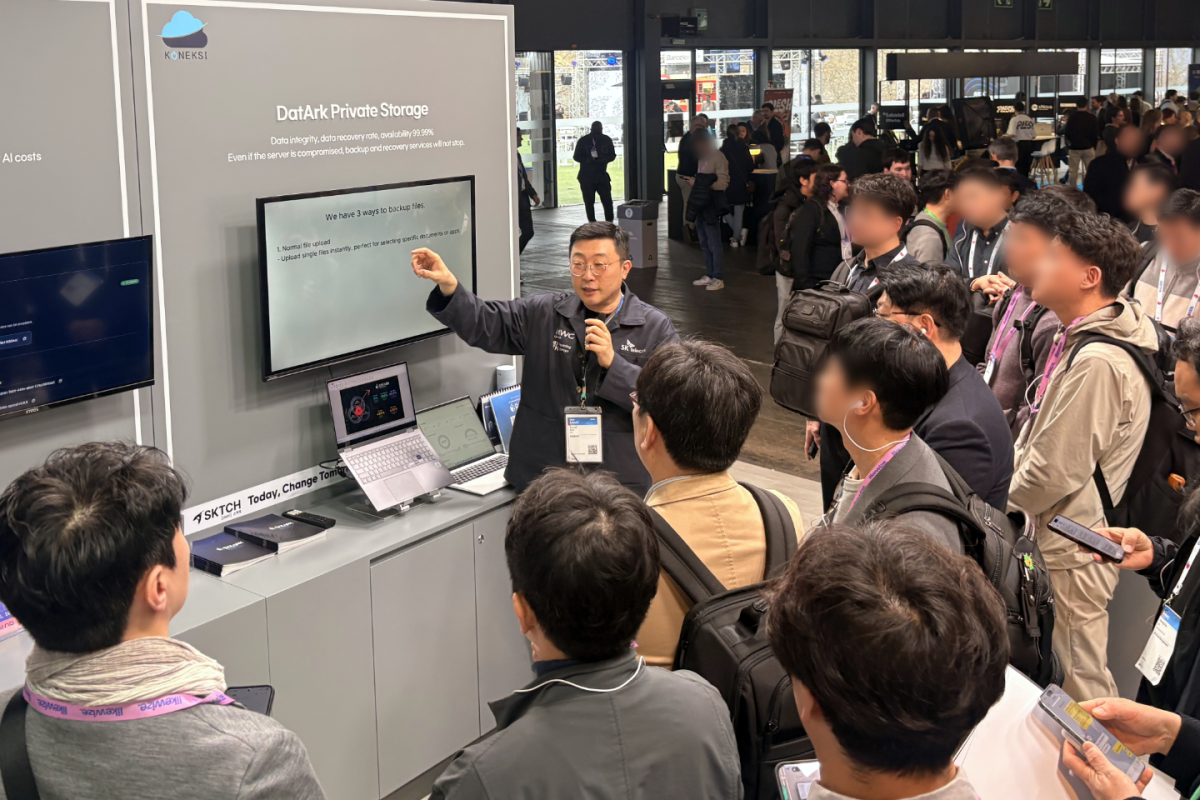
A. Connexi (CEO Choi Young-il): What we do is distribute important data securely across multiple locations instead of storing it in one place, while enabling immediate verification of its authenticity when needed. Even if data is lost, altered, or attacked, we create a structure that allows it to be verified and restored.
■ Protecting data by splitting it
When security managers at large financial institutions expressed fatigue from deploying dozens of personnel every night to back up tens of terabytes of data, Connexi proposed this: “Don’t ‘perform’ backups separately. Make backups ‘complete’ the moment the data is stored.”
Q. What was the most difficult moment during the development of your technology?
A. Enerzai (CEO Jang Han-him): The most painful moment was when our research was hindered by the limited resources of a startup. Ironically, building ultra-small AI models requires a large number of GPUs. While we help customers use AI without GPUs, we ourselves lacked GPUs for research. We overcame this by actively seeking support from large companies’ startup programs. It was a moment when we realized a life lesson: if you truly want something, you must actively ask for help.
A. Connexi (CEO Choi Young-il): The hardest part was turning a good idea into technology that works in real customer environments. What works in a lab must also overcome barriers of speed, cost, and integration with existing systems in the field. Instead of trying to create a perfect solution all at once, we moved forward by identifying potential problem points early and addressing them in advance.
A. InvaLab (CEO Shin Won-hyeop): The most difficult part was simply the fact that it takes time. It takes seasons for plants to grow and gain a competitive advantage, and during that time, it’s not easy to convince investors and customers that “things are going well.” We overcame this by using multispectral drone imagery to visualize vegetation changes that are not visible to the naked eye. Over time, the difference compared to conventional methods became clear, and this accumulated data became a unique asset for InvaLab.
Q. What was the most impressive moment at MWC?

Jang Han-him, CEO of Enerzai, introducing the company’s on-device AI technology at the MWC26 4YFN exhibition hall. (Photo courtesy of Enerzai)
A. Enerzai (CEO Jang Han-him): I spotted a representative from a partner company I had really wanted to meet but hadn’t had the chance to connect with, walking in the distance. I ran over and secured a meeting. We also invited representatives from a European telecom company we’re currently in contract discussions with to our booth and demonstrated our solution, which helped accelerate the deal.
A. InvaLab (CEO Shin Won-hyeop): At MWC, an IT and telecommunications event, I realized that interest in natural capital solutions was much broader than expected. We made an unexpected connection with a local ecological institution in Barcelona, and that has now progressed to formal meetings.
A. Connexi (CEO Choi Young-il): The most memorable moment was a conversation with a PhD student specializing in cybersecurity. He mentioned a recent data breach at the Barcelona tax authority and shared the local distrust toward existing cloud infrastructure. I could clearly see why European companies prefer Swiss infrastructure and how urgent the issue of “data trust” is. In fact, we are currently receiving proposals for technical validation from global companies in Europe and the U.S. and are in discussions.
A path that becomes faster when walked together
Q. As a startup, what does the “technology ecosystem” look like to you?
A. Connexi (CEO Choi Young-il): I believe a technology ecosystem cannot be completed alone. Startups can quickly define problems and experiment, while large corporations have infrastructure, markets, and real customer touchpoints. What’s important is not to see each other simply as suppliers and consumers. When you solve even small problems together, trust is built, and that can lead to bigger projects.

Shin Won-hyeop, CEO of InvaLab, introducing ecological restoration technology to SK Telecom CEO Jaeheon Jung at the MWC26 4YFN exhibition hall. (Photo courtesy of InvaLab)